
Our Latest Articles
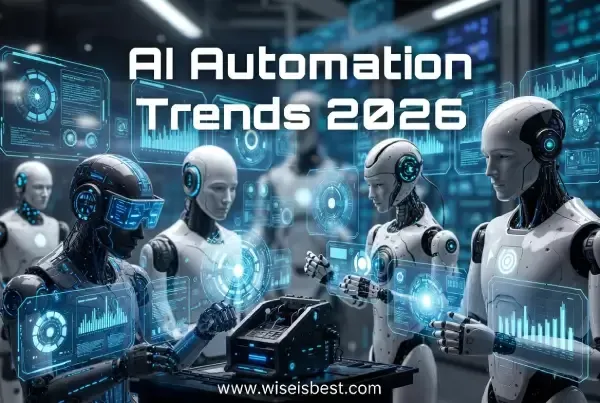
AI Automation Trends 2026
AI Automation Trends 2026: What Business Owners Need to Know to Stay Ahead
In the fast-evolving landscape of 2026, AI automation isn't just a buzzword—it's a game-changer for businesses looking to boost efficiency, cut costs, and scale operations. As a business owner, understanding these trends can help you integrate AI tools that drive real ROI, with reports showing productivity gains of 20-40% for early adopters. Whether you're in manufacturing, marketing, or services, AI is shifting from simple task automation to intelligent, autonomous systems that handle complex workflows. This article breaks down the top trends, backed by expert insights, and explains how they can transform your business. At WiseIsBest.com, we specialize in helping businesses navigate these changes with tailored AI strategies—let's dive in.
1. The Rise of Agentic AI: From Assistants to Autonomous Teams
Agentic AI is emerging as the cornerstone of automation in 2026, where AI agents act independently to achieve goals, coordinating like a digital workforce. Unlike basic chatbots, these systems form multi-agent teams that handle end-to-end processes, such as customer support or supply chain management, with minimal human input. For business owners, this means rethinking operations: agents can orchestrate tasks across environments, turning you into an "AI composer" who sets high-level goals while the system executes.
Key benefits include scalability—market projections show agentic AI growing from $12-15 billion in 2025 to $80-100 billion by 2030 at a 40-50% CAGR. In practice, a retail business could use agentic AI to monitor inventory, predict stockouts, and reorder automatically, reducing downtime and errors. However, success requires redesigning processes; Gartner warns that 40% of agentic projects may fail if they automate flawed workflows without transformation. Start small: Pilot agentic tools in one department, like HR for onboarding, to measure ROI before scaling.

2. Physical AI: Bridging Digital Intelligence with Real-World Action
Physical AI, the convergence of AI and robotics, is set to redefine automation in physical environments. This trend embodies AI in robots that "sense, reason, act, and learn," addressing labor shortages (projected at 3.5 million unfilled roles by 2030) and reducing annual downtime costs of $1.5 trillion. For businesses in manufacturing or logistics, physical AI means robots that autonomously navigate warehouses, optimize routes, and handle tasks like assembly with 10% efficiency gains, as seen in Amazon's deployments.
The market is exploding, expected to exceed $1 trillion by 2030 with over 20% CAGR. Business owners should prepare by integrating AI with existing hardware—think self-driving vehicles in factories or AI-powered drones for inventory checks. Challenges include high initial costs, but ROI comes from endurance: robots don't tire, reducing turnover in repetitive roles. To implement, assess your operations for physical bottlenecks and partner with vendors for hybrid human-robot teams.
3. Hyperautomation and Intelligent Process Automation: End-to-End Efficiency
Hyperautomation combines AI, machine learning, and robotic process automation (RPA) to automate entire business functions, from finance to sales, eliminating silos and delays. In 2026, this becomes standard, with intelligent systems learning from data to improve over time, such as automating invoice processing from receipt to payment.
For business owners, the payoff is massive: faster execution, lower costs, and error reduction. McKinsey reports 20-40% productivity boosts by focusing humans on strategy while AI handles repetition. In marketing, AI-driven ad optimization and predictive analytics can personalize campaigns at scale, with the market growing from $47.32 billion in 2026 to $107.5 billion by 2028. Low-code platforms democratize this, allowing non-tech users to build workflows. Tip: Map your processes, identify automation candidates, and use tools like UiPath for multi-agent setups to ensure compliance and security.
4. Predictive AI and Decision Support: Proactive Business Intelligence
AI is evolving from reactive tools to predictive engines that forecast issues like customer churn, demand spikes, or fraud, enabling proactive decisions. In 2026, decision-support AI analyzes patterns to suggest actions, shifting from task automation to strategic aid.
Business applications are vast: A service company could use AI to predict equipment failures, saving on repairs, or personalize customer interactions where 73% of consumers expect brands to understand their needs. Forbes predicts job displacement in routine roles but emphasizes adapting humans to oversight and creativity for overall gains. To leverage this, invest in data modernization—unified pipelines are key, with the enterprise AI market hitting $1.5-2 trillion by 2028. Start by integrating AI analytics into your CRM or ERP systems for real-time insights.

5. AI Governance and Security: Building Trust in Automation
As AI scales, governance becomes critical for compliance, explainability, and risk management. In 2026, 68% of leaders prioritize AI risk governance, with regulations like the EU AI Act demanding auditability. For businesses, this means secure deployments with data sovereignty—93% of executives will factor this into strategies to avoid breaches.
Identity management for AI agents is essential, as they may outnumber human users. Deloitte highlights securing AI across data, models, and infrastructure while using it for cyber defense. Business owners should adopt "governance-as-code" for agent alignment and continuous monitoring. This builds a moat: Trusted AI leads to sustainable scaling and customer confidence.
Conclusion: Embrace AI Automation for Business Growth in 2026
These trends signal a shift to AI-native operations, where automation drives innovation and competitiveness. Business owners who act now—redesigning processes, investing in data foundations, and prioritizing governance—will reap the rewards. At WiseIsBest.com, we offer expert guidance and tools to implement these trends seamlessly. Visit us today to explore how AI can automate your business for maximum efficiency and growth.


Empowering businesses with innovative solutions, we are committed to providing seamless support and fostering growth. Connect with us for a brighter, smarter future!
Quick Links
Contact Us
Legal
© MidMichPOS 2026 All Rights Reserved. Est. 2016